Mentorship in the Herding Dog Community: How It Actually Works
A practical guide to finding a mentor, building the relationship, and getting the most out of the most valuable resource available to new herding dog handlers.
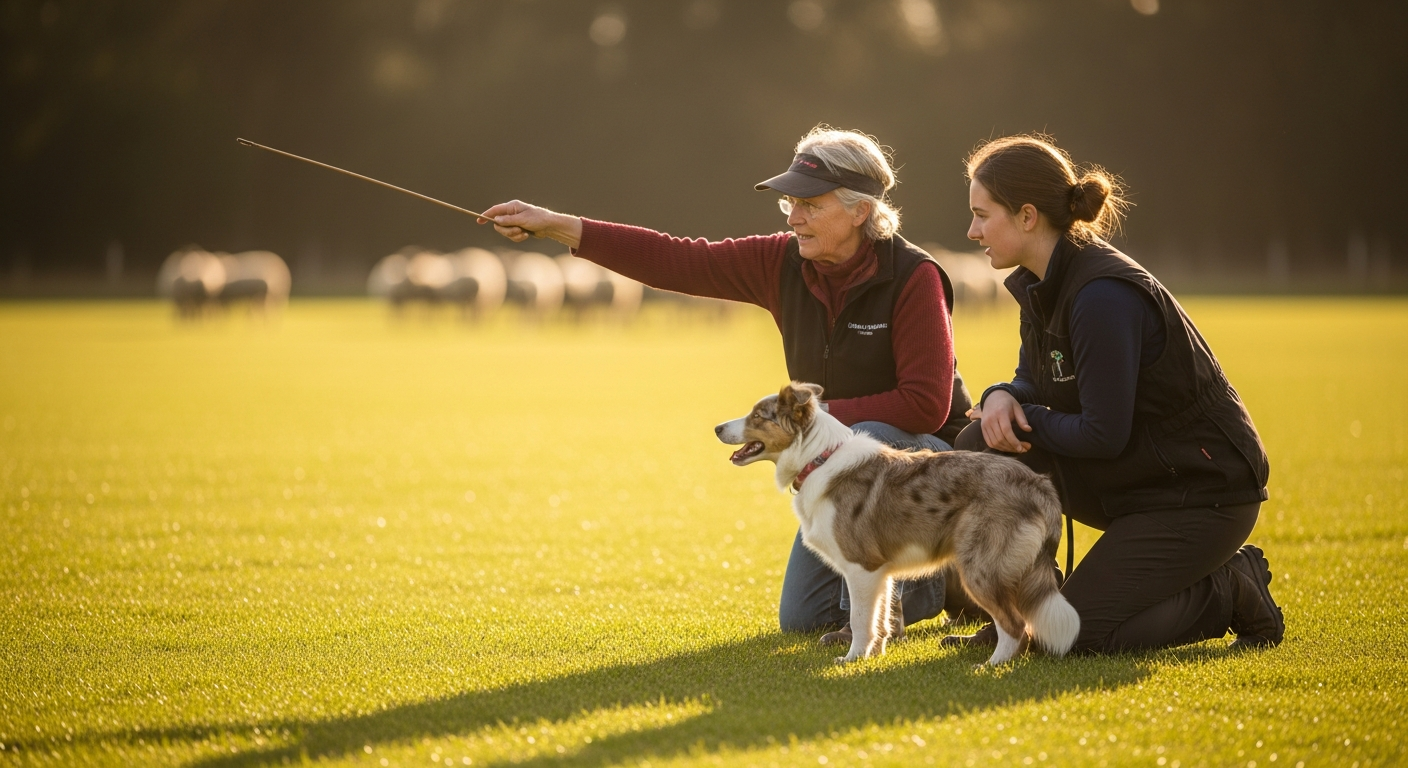
Every experienced herding dog handler has the same story, told with the same reverence. There was a mentor. There was usually more than one. The knowledge that carries a handler through a forty-year relationship with herding breeds does not come from books and videos alone. It comes from the hundred small corrections delivered at the right moment by someone who has been through what you are going through, and who is willing to share what they learned from the dogs that came before yours. This article is about how to find that person, how to approach them, and how to build the relationship that will shape your decades with these dogs.
What a Mentor Actually Does
There is a romantic version of mentorship where the mentor tells you things and you take notes. This is almost entirely wrong. A real herding-dog mentor does four things, in varying proportions depending on the stage of your relationship.
First, the mentor watches you work with your dog and tells you what they see. This is the single most valuable function of a mentor, because you cannot see yourself. An experienced handler will notice that your left hand is rising two inches when you give a command, creating confusion in the dog that you are incorrectly attributing to the dog's lack of focus. You cannot see the hand. The dog cannot explain the confusion. The mentor sees both and connects them.
Second, the mentor translates your dog's behaviour into language you can act on. A dog that is "being weird" in your description may be a dog that is "reading the stock correctly and you are blocking the line" in the mentor's description. The translation is the mentorship.
Third, the mentor sets the ceiling of what is possible. When a new handler has a young dog that is struggling, the mentor knows whether the struggle is normal developmental fog or whether it is a structural problem in the training. This calibration - knowing when to push through and when to back up - takes decades to develop independently. A mentor gives it to you in months.
Fourth, the mentor introduces you to other mentors. Mentorship in the herding dog world is a network, not a pair. Your primary mentor will eventually refer you to people who know what they do not. A Border Collie mentor will send you to an Australian Shepherd person when you cross into that breed. A sheepdog trialer will connect you to a cattle worker. This network is the entire infrastructure of knowledge transmission in the sport.
How to Find a Mentor
The correct order of operations is clinic first, mentor second. Take a herding clinic with a respected instructor before you try to establish a one-on-one relationship. The clinic reveals which instructors communicate in ways that match your learning style, which dogs they have produced, and which other students they attract. You will learn more about the instructor in a weekend clinic than in any number of phone conversations.
After the clinic, if you have identified an instructor whose work you respect, follow up. Send a specific, short email that references something specific that was said or done at the clinic, thank them for the time, and ask whether they take on students for ongoing lessons. Do not send a long email describing your dog's whole life story. The instructor has run many clinics. They remember the people who were respectful, attentive, and specific; they do not remember the people who wrote three-page essays about themselves.
The mentor relationship usually starts with paid lessons. This is appropriate. The instructor's time has monetary value, and a handler who expects free mentorship on the basis of enthusiasm is signalling that they do not value what is being given. Pay for lessons until a relationship has formed. If the relationship evolves into an unpaid friendship with ongoing informal instruction, that is a gift. It is not something you can ask for; it is something that happens slowly, with mutual respect, over time.
Our guide to breed clubs covers the other major route to mentorship, which is club-based informal apprenticeship. Breed clubs have senior members who are often willing to spend time with younger handlers at events, clinics, and workdays, and a newcomer who volunteers at the club's spring work day has started a relationship that can pay dividends for years.
The Etiquette of the Mentor Relationship
Mentorship in the herding dog world has a set of unwritten rules that every newcomer should internalise. Violating them is the fastest way to lose access to the knowledge networks you are trying to enter.
Show up on time. If you are booked for a ten o'clock lesson, you are tacking up your dog at nine forty-five, not arriving at ten-ten with a coffee. The mentor has usually set aside the full morning for you; being late costs them time they will not get back.
Take notes. Actual notes, in a notebook, with a pen. Writing down what the mentor says is both a practical aid to retention and a visible sign of respect. I have watched mentors light up when a new student pulls out a notebook for the first time; they have seen hundreds of students who assumed they would remember what was said.
Do your homework. If the mentor gives you something to practice between lessons, practice it. Showing up two weeks later having not practiced, and asking for new instruction, is a form of insult. A mentor's time is precious. Their willingness to invest it in you is proportional to your willingness to invest in what they give you.
Close the feedback loop. When you implement what the mentor has taught you, tell them how it went. A short text or email describing a breakthrough or a setback is not just polite; it gives the mentor information they need to calibrate the next lesson. Mentors work in the dark if students do not report back.
Attend their trials, their clinics, their breed demonstrations. Physical presence is a currency in this community. A student who shows up to the mentor's events, watches respectfully, and helps with setup is a student the mentor remembers when they are recommending dogs, sharing breeding information, or passing along an opportunity.
What to Realistically Expect in Year One
The first year with a mentor, for a new handler with a young dog, is usually about fundamentals. You will probably spend the first several lessons on your own mechanics before the mentor does much with the dog. Hand position, voice, timing, body language, the ability to stand still and let the dog think - these are the subjects. If you expected to learn shedding and driving in the first year, you will be disappointed. If you expected to learn how to be a calm, readable handler, you will be exactly where you should be.
Progress in the first year is not linear. You will have lessons that feel like breakthroughs and lessons that feel like regressions. Both are part of the process. A good mentor will tell you, repeatedly, that the dog has not forgotten what they learned; you have forgotten how to cue it, or the environment has changed, or the dog is in a developmental phase. Patience with the non-linear progress is the hardest thing to cultivate and the most important thing a mentor will try to give you.
Our community's training resources directory lists the books, videos, and podcasts that serve as supplementary material for the first-year student. Read the material, but remember that reading is a support for lessons, not a substitute.
When the Relationship Changes
A long mentor relationship evolves. The instruction-heavy early years give way to a friendship-heavy middle period, where the mentor is less a teacher and more a sounding board. You will call them about breeding decisions, about difficult training problems, about the ethical questions that come up with working dogs. The relationship matures into the kind of professional friendship that characterises most of the long-term connections in the herding dog world.
Eventually, you become a mentor yourself. New handlers will approach you with their specific, respectful emails, and you will recognise yourself ten years earlier in their tone. The debt you owe to your mentor is paid forward, not back. This is the structure of the community, and it is how the knowledge has moved through generations of working-dog people since the breeds were founded.
A Final Word on Humility
Every experienced handler will tell you the same thing: the dogs are the teachers, and the human mentors are only translators. The goal of mentorship is to produce a handler who can read the dog directly, without always needing the translator. A mentor who keeps you dependent is a bad mentor; a mentor who eventually makes themselves redundant in your specific practice is a great one.
If you have found a mentor who is generous with their time, honest in their feedback, and rooted in their respect for the dogs, you have found something rare and valuable. Treat it as such. Show up. Do the work. Say thank you, in person and in letters and in small physical gifts on the right occasions. The herding dog community is built on these relationships, and every good one that exists keeps the whole thing alive for the next generation.
If you are at the start of this journey, our welcome guide covers the basics of the community, and the networking guide walks through how to build the first professional connections that eventually lead to mentorship.